
Nabhari v Australia (HRC, 2024)
Violations: ICCPR art 9(1)
 Unremedied
The UN says:
HRC (2024)[Australia] is under an obligation to provide the author with an effective remedy. … [T]o make full reparation … provide [her] with adequate compensation for the periods of her detention on Christmas Island, … Nauru and on mainland Australia.
[Australia] is also under an obligation to take all steps necessary to prevent similar violations from occurring in the future. In this connection, [Australia] should review and modify its migration legislation and policies and any bilateral offshore transfer arrangements for migrants as to their content, implementation and monitoring, to ensure their conformity with … the Covenant.
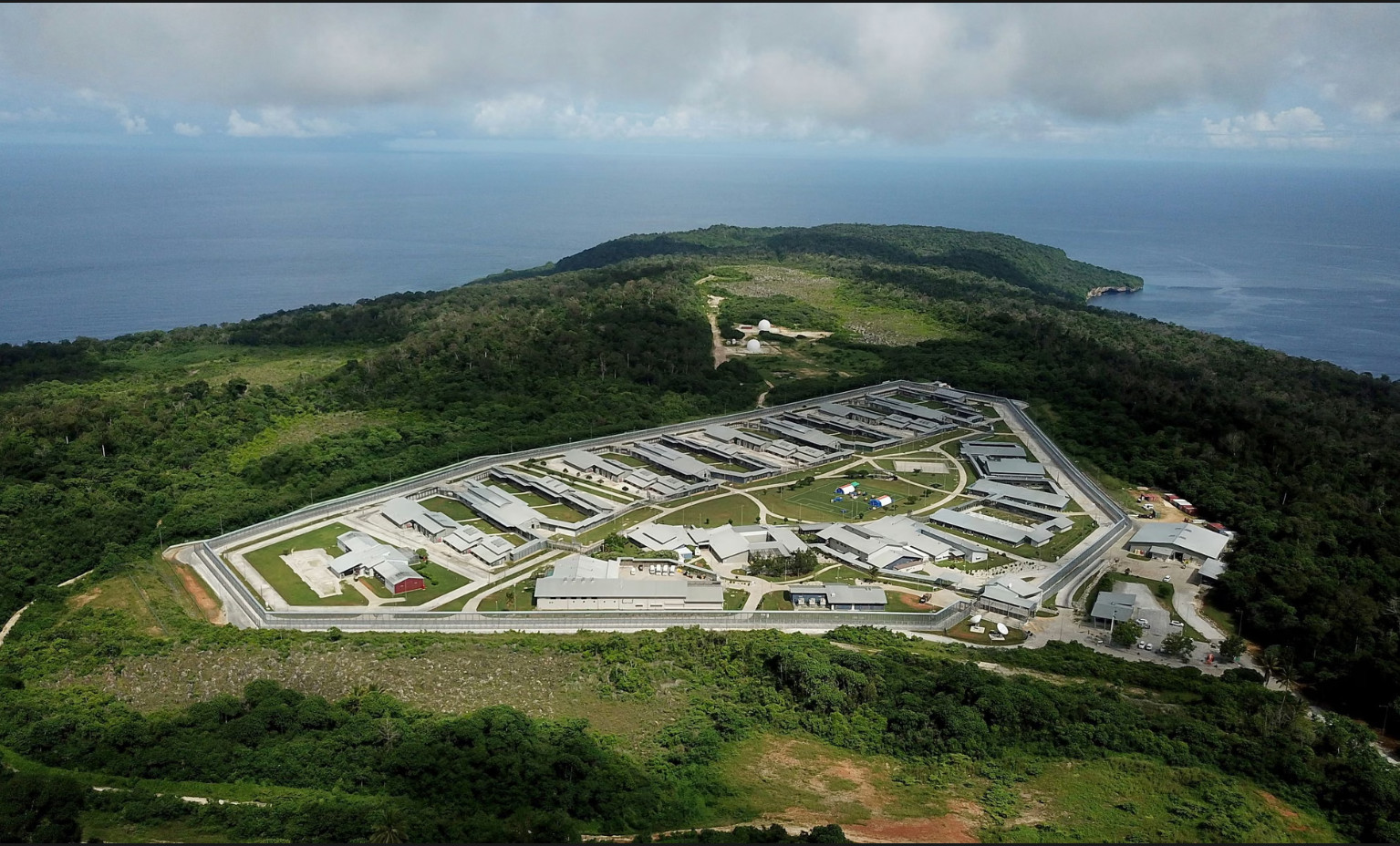
The immigration detention centre on Christmas Island, 1,500km west of mainland Australia (photo: Stringer/Reuters/The Guardian)
A 27-year-old Iranian refugee named Mona Nabhari arrived in Australia by boat without an entry visa in August 2013. Ms Nabhari and her husband, stepfather, stepsister (then a child) and a cousin arrived on Christmas Island, which is an Australian territory in the Indian Ocean, 1,500km west of the Australian mainland. They were detained on the island.
The year prior, Australia came to an arrangement with the Pacific island nation of Nauru to send people seeking asylum in Australia to be detained there and have their refugee claims assessed by Nauru (a recent party to the Refugees Convention).
After nearly 7 months detained on Christmas Island, Australia sent Ms Nabhari and her husband to Nauru. Nauruan authorities took 3 further years to determine their refugee status, recognising them as refugees in April 2017. Even so, they remained in detention on Nauru for over a year more, during which time Ms Nabhari self-harmed.
In November 2018, they were evacuated from Nauru on medical grounds, and put in detention on mainland Australia, despite being recognised refugees.
In early 2019, Ms Nabhari’s stepfather and stepsister were also transferred to Australia for medical reasons, but to a different city. In May 2019 (after two months’ separation, according to Australia; para. 4.10), Ms Nabhari and her husband were moved to the same city as her stepfather and stepsister, but remained in detention. (The location of Ms Nabhari’s cousin is not recorded.) Ms Nabhari claimed violations of her rights to family under articles 17 and 23 of the Covenant, but the Human Rights Committee found these claims insufficiently substantiated and did not find violations of these provisions (para. 7.4).
Interim measures
On 9 October 2019, as part of her individual communication to the UN Human Rights Committee, Ms Nabhari asked the Committee to take interim measures. The Committee complied on 25 October 2019, asking Australia to immediately release Ms Nabhari and her husband. On 29 October, the Australian Minister for Immigration intervened to have them released, which took effect on 4 November.
Her petition to the UN covers over 6 years, from August 2013 to November 2019 (excluding 3 months in which they were not detained, while on Nauru; para. 7.17).
“She feels ready to die because she has no rights and doesn’t feel human any more.”
In response to the communication, Australia argued that events occurring on Nauru were outside its jurisdiction. The Committee, looking at a range of factors, did not accept this claim (paras 4.3 & 7.6-7.15).
Australia argued Ms Nabhari could have sought review of her detention by the High Court of Australia or filed a writ of habeas corpus (para. 4.9). The Committee did not accept that either of those remedies was available to the author while she was in Nauru, besides which, the High Court decision in Al-Kateb v Godwin (2004) established that indefinite detention of refugees was lawful in Australia. The possibility that the court might one day overrule its own precedent does not make the High Court an effective remedy for immigration detainees. The Committee cited its previous jurisprudence, noting “there is no obligation to exhaust domestic remedies if they have no chance of being successful” (para. 7.3).
The Final Views of the Committee and the individual view of a Committee member making various important observations about Australia’s human rights obligations and treatment of people seeking asylum:
- The rights in the ICCPR belong to everyone, both citizens and non-citizens, without discrimination (para. 7.5; see paras 1 & 2 of the Committee’s General Comment No. 15 (1986) on the position of aliens under the Covenant)
- Detention that is lawful under Australian law may nonetheless be arbitrary (and a breach of art. 9(1); para. 8.3)
- Detention for the purpose of immigration control is not arbitrary per se, but must be reasonable, necessary, justified and proportionate, and reassessed as it extends in time. The decision to detain someone seeking asylum or to continue detaining them “must consider relevant factors on an individualised basis,” and “must not be based on a mandatory rule for a broad category,” such as occurs in Australia, and must consider “less invasive means of achieving the same ends, such as reporting obligations, sureties or other provisions to prevent absconding; and must be subject to periodic re-evaluation and judicial review” (para. 8.3).
People seeking asylum “may be detained for a brief initial period in order to document their entry, record their claims and determine their identity if it is in doubt. To detain them further while their claims are being resolved would be arbitrary in the absence of particular reasons specific to the individual.” (para. 8.3)
- Australia must respect and ensure the rights of anyone “within [its] power or effective control” even if outside Australian territory (para. 7.5)
- Australia has power and effective control over the detention of people it sends to Nauru. Under the arrangements in place at the time, physically transferring people to Nauru does not extinguish Australia’s human rights obligations towards them (para. 7.15).
The sole, undisputed reason for Ms Nabhari’s detention was her unauthorised entry into Australia by boat (para. 8.5). Australian migration law does not require individualised reasons for ongoing detention of people seeking asylum (para. 8.6) and provides no effective means for such a person to challenge their detention (para. 8.7).
The Committee concluded that the author’s detention in both Australia and Nauru was unreasonable, unnecessary, disproportionate and arbitrary, and a breach of Article 9(1). Arbitrary detention is a gross violation of human rights.
The individual opinion by one member of the Committee addresses “a cynical and concerning trend” in migration policy of “externalising borders” and “offshoring” refugee protection (paras 1 & 6). The Committee’s Final Views should send a “clear message” to all nations party to the International Covenant on Civil and Political Rights: they can be responsible for human rights violations that occur outside their territory if they forcibly transfer people seeking asylum to other countries with inadequate ‘systems, standards and resources’ (para. 6).
“Offshore detention facilities are not human-rights free zones...
“Where a State exercises effective control over an area, its obligations under international law remain firmly in place and cannot be transferred.”
-- UN Human Rights Committee, January 2025
The UN Refugee Agency (UNHCR) called it a “landmark decision” for holding Australia responsible for the rights of people it transfers abroad, “consistent with UNHCR’s long-held position.” The UNHCR "stands ready to work with the Government of Australia to help it uphold its international obligations under the ICCPR as well as the Refugee Convention.
Australia’s response
In October 2025, Australia responded to the Committee’s Views (exceeding the 180-day deadline) by restating its arguments in defence of its treatment of Ms Nabhari. Australia rejected the Committee’s main conclusions. Australia argued that no human rights violations had occurred, yet also that it is not responsible for events “on foreign soil”. It therefore refused to compensate Ms Nabhari or alter its migration legislation or policies.
According to Amnesty International, the number of people seeking asylum who Australia had transferred to Nauru grew to over 100, as at January 2025.
“Offshore detention is a policy characterised by sheer cruelty, a dead end that has caused irreparable harm to countless people seeking safety. For over a decade, people seeking refuge in Australia have endured unimaginable suffering in Nauru.”
– Amnesty International, 2025
Read the full decision: Nabhari v Australia (October 2024)

Accommodation for detainees on Nauru (photo: Australian Dept Immigration)